Hello Friends!
Having reached Lughnasadh and Lammas, halfway between the Summer Solstice and the Autumn Equinox, we are moving into late summer and fair and sweet corn season. I’m not much of a fair goer, I like the concept, but the crowds are too much for me. If I go to the State Fair in St Paul—The Great Minnesota Get Together—I have to really pump myself up for it. And I somehow inevitably end up going on what turns out to be the hottest day of the fair. As a result, I have not been in years and years. I kind of want to go, and maybe I will—next year. That way I will have time to prepare myself.
We do have a little Lammas celebration at my house though since the local sweet corn shows up here around August first. James has not had time to cook the sweet corn we bought Saturday, but he did make cornbread-blueberry waffles for breakfast this morning. Soon we will have some proper corn dish. I have a recipe for corn fritters I want him to try out this year. I really wish I could grow my own corn (I have tried many times!) but the forking squirrels make it impossible.
It is also cicada season here. We don’t get those big hatchings like they do in other parts of the United States, we just have the run-of-the-mill annual cicadas buzzing in the trees and bushes. I love their noise even if seeing them alive freaks me out every time because they are so huge and I don’t immediately recognize what the big bug is because they don’t make it habit to leave the shrubbery. Once I realize who the critter is, I relax and greet them joyfully. Maybe one of these days my initial eek! reflex will go away because it must be quite a blow to the insect’s self-esteem to have me eeking at them before apologizing and saying hello.
I heard the first cicada a little over a week ago, and then everything went silent during our last brutal heat dome (Last Sunday it was 99F/37C and then Monday it was 100F/38C. The dew point that morning was 81F/27C, which tied for second highest dew point on record. Thankfully the dew point had dropped several degrees before the temperature shot up.) from cicadas to crickets to birds and people, silently enduring. Even the raccoons left us alone (The little effers have since returned and now I have to bring my culinary ginger I am growing in a pot on the deck indoors at night so they don’t dig it up again).
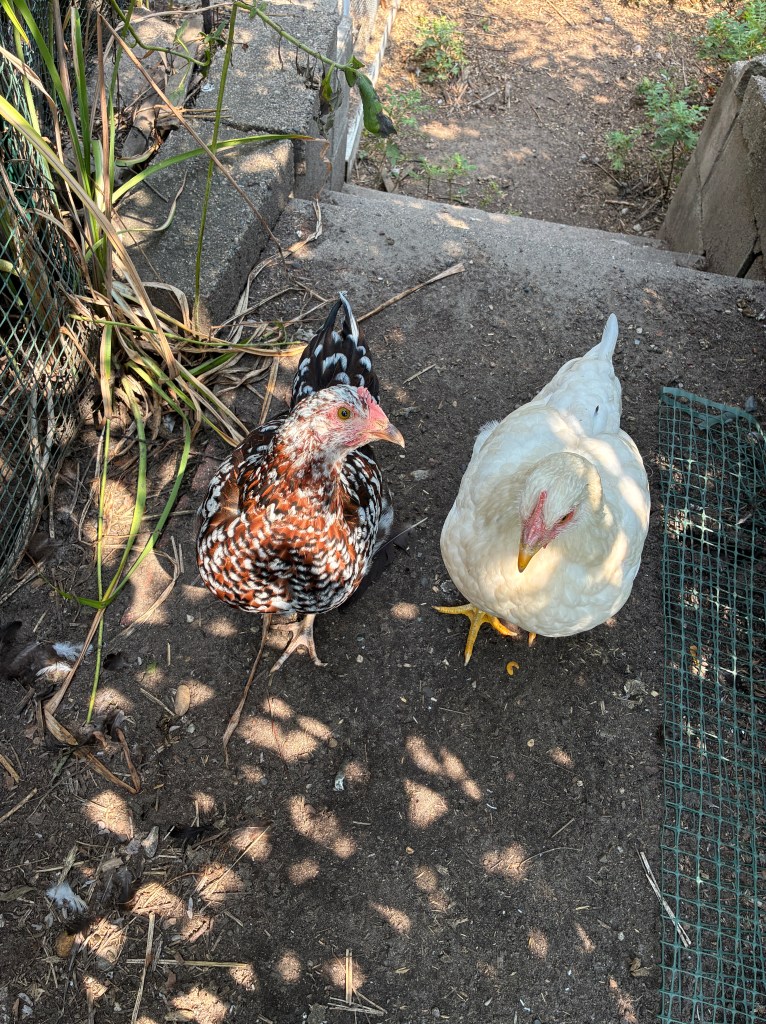
The poor chickens, who don’t have sweat glands, dug themselves deep wallows in the dirt beneath the elderberry and splooted in their holes, panting and moving as little as possible.
The garden suffered greatly. Everything drooped. We were so hot and dry (Friday it rained 1.5 inches/3.8 cm!) and I couldn’t water everyone enough. We tried and most everyone managed to pull through except the skunk, scarlet runner and Hidasta pole beans. They died before barely producing any beans. And the butternut this year is puny and sad and at this point is not likely to produce a single squash. The volunteer pumpkin managed to pull through and the long pie pumpkin, which has a small pumpkin the size of a softball, is not quite dead. The green striped cushaw however, reveled in the heat; a surprise because the dinner plate-sized leaves drooped alarmingly. There are three vines and between them four or five squashes. One of them is as large as a child’s head!

This is the first year I have grown green striped cushaw. They are a winter squash that can reach up to 20 pounds/9 kg. They are resistant to squash vine borer and powdery mildew and, unlike most other squashes, appreciate warmer weather. Their origins seem to be disputed. Monticello says they are from the West Indies while Wikipedia says they originated in southern Mexico. I have also seen some say they originated with Native Americans in the southeast United States. Maybe it is all true because the squash has been grown for around 8,000 years and plants and people move around and change. Cushaws are a versatile squash and can substitute for pumpkin. If we end up liking their flavor, I’m thinking I might give up growing pumpkin and go all in on cushaws.
And if summers continue to be like this one, I might need to find a butternut substitute as well. I am saddened by that thought because I love butternut squash. However, if you know of a good butternut substitute I could try that is heat tolerant, please let me know!
There is not much to do in the garden this time of year besides keep things weeded and watered and harvest the fruits of my labor from earlier in the season. I am almost done pruning out the raspberry canes that fruited this year so the canes that will fruit next year have plenty of room to grow. And I did plant kale, turnips, Swiss chard, winter radish, cabbage and kohlrabi for fall harvesting. I’ve not had much success in the past with fall harvests, but I keep trying and maybe will get it figured out through trial and error. With fall lasting well into the end of October these days late season vegetables have more of a chance to make it to maturity.
But really, it’s the part of the growing season where I’m kind of tired and find motivating myself to do any large garden projects a challenge. The days are noticeably shorter and the energy of spring and early summer is waning. There will be plenty to do in the weeks to come—the aronia is starting to purple and the elderberries will soon follow, the Kentucky wonder beans are covered in flowers, the tomatoes are tomatoing, the lemon cucumbers are almost ready to start picking, and the lima beans and black-eyed peas are both lush and covered in flowers. But for now, it is good to be able to sit back and take a few breaths, relax for a week or two, and gather my energy before the mad rush to the end of the growing season begins.

We’ve had corn in the markets for a couple of weeks here, and it is delicious! Been buying in bulk and eating in bulk too 🙂 I didn’t know about cushaw, or Lughnasadh, or Lammas, so I enjoyed following the links and reading more about them and their various origins. Glad you don’t have much to do in the garden – can’t be fun gardening in that heat. Stay cool! It’s 36-38 all week here (upper 90s F), and I’m staying inside as much as possible.
LikeLiked by 1 person
Your growing season must be a few weeks ahead of mine. Happy to hear you’ve been enjoying delicious sweet corn, it’s a summer favorite of mine. 🙂
LikeLiked by 1 person
I haven’t been to a fair in many years myself. The last time we went, we went with this couple that completely hyped up the fair in Elkhart Indiana. It’s supposed to be the biggest fair in the state, and we went on the hottest day of the year. Oddly, the couple didn’t want to actually do any fair stuff, they only wanted to eat fair food. I tried to keep up a bit, and after we left, I was so miserable and hungry for actual food. We went to a Chinese restaurant, and after being in the heat and eating too much sugar and fried stuff, the pattern on the blind started to make me feel dizzy, and we had to leave. Of course, we didn’t make it home without me throwing up first. Oh, a fair is a fair is a smorgasborg.
LikeLiked by 1 person
Heh, lots of people here go to the fair just for the food. All the local news outlets release a list of all the new fair food every year. I like looking at the list because there are always a couple that make me wonder who would actually want to eat that because it sounds disgusting. 😀 Your last fair experience sounds terrible and would definitely put me off wanting to go for a very long time.
LikeLiked by 1 person
I love fairs! I just played the fiddle with my Celtic group at the local county fair and then the next day I took my grandson to see the horses, cows, goats, rabbits, chickens, and turkeys.
I also love cicadas. They are grinding, whirring, humming in the woods behind my house. It’s a lovely time of year.
LikeLiked by 1 person
That is so awesome that your Celtic group plays at your local fair Jeanne! If I knew someone who was performing I would definitely be more likely to want to go. The times I have gone, I do very much enjoy the animal barns and I love the seed art and looking at the various textile competition entries. It’s the crowds and the heat that get to me.
Oh I would love hearing all the cicadas buzzing away in the woods, what music!
LikeLiked by 1 person
I’m sorry some of your beans and squashes aren’t making it in the heat. I hope you all get a cool down soon.
Cornbread blueberry pancakes sound amazing!
I used to go to the local fair with friends a lot in my teens and twenties. We took our James a couple of times when he was younger. It’s usually so hot here too, it makes it not super fun. I do admit that I like fair food!
LikeLiked by 1 person
Thanks Laila! Summer has returned to “normal” but it is too late for the beans and squashes. There’s always next year!
I know plenty of folks don’t mind the heat, but I just melt and my James ends up exhausted. Finding something vegan at the fair made it not fun to go in addition to the heat, but now there are several places with vegan offerings that there is actually a choice and they generally aren’t deep fried on a stick 😀 I think I am working myself up to go next year. We’ll see 🙂
LikeLiked by 1 person