
After a summer during which I didn’t have to water the garden once because it rained every few days, the faucet has been turned off. We’ve been dry since the last week of August. Oh we had thunder and rain yesterday afternoon, but while the thunder rumbled for nearly half an hour, the rain fell for only ten minutes, barely enough to wet the top of the soil. Our rain barrels are empty and we are using gray water from the house—from the dehumidifier, air conditioner, shower, and dishwater–to keep the garden hydrated.
I am grateful the dry has come at the end of the growing season rather than the beginning or middle. The butternuts and pumpkins are working on ripening, we are still getting jalapeños and cayenne peppers. It looks like I will get a second zucchini after all, picked at normal size to eat fresh. And, I am still picking tomatoes and green beans every evening. With the water diet, the tomatoes are much smaller than they were in July. The beans, they just keep going. So many beans this year! I think I mentioned we fermented four quarts of green beans. They came out great! Crunchy with a slightly sour bite, sort of like pickles. Really pleased with them. And we still have a huge bag of fresh frozen beans in the freezer. Plus, we eat them fresh from the garden too. We will happily be eating green beans for sometime to come.
Speaking of beans, the dry weather has been good for picking the shelling beans. From saved seed I grew Iroquois skunk beans, a prolific black and white speckled pole bean, and Holstein black-eyed peas, also black and white. I apparently have a thing for black and white beans! Heh.
Also from saved seeds I grew brown resilient beans. These bush beans were bred by Carole Deppe, author of some fantastic gardening books as well as a plant breeder. I grew these for the first time last year. My seed packet came with maybe 15 seeds in it. I planted them all. Then we had a bad drought, but the beans still were doing pretty well. And then a rabbit invaded and ate half the bean plants. But some of them actually came back and still produced beans. So these definitely are resilient! Still, I didn’t get enough beans to actually eat, I saved them all for seeding this year. And once again they did great, especially without any drought. But some of them were eaten by a rabbit, again.
Rabbits seem to like bush beans quite a lot. The rabbit ate all of the bush green beans down to nubs. And with half of the resilient beans chewed down I thought, I’m done with bush beans. But the resilient beans recovered, and some of them are still producing beans. When the pods began to dry and I began picking them I discovered the medium to dark brown beans I saved from last year produced a variety of colors this year. I’ve got dark and light brown, tan, yellow, white, and black beans. This is because of all the crossings Deppe did to get the brown beans. They are not truly reverting, but they are showing their widely various genetics, which is what makes them so resilient. The color variety has made me want to grow them again just to see what happens next year. Plus, in spite of the rabbit, they were really productive.
First time beans in the garden were Hidasta Red, Succotash, and lima. The Hidasta red is a pole bean and was moderately productive with its pretty red beans. I saved some to try again next year. The succotash beans are dark purple and look like big corn kernals. The story is that these pole beans were grown by the Narragansett peoples in what is now Rhode Island and were part of a succotash vegetable dish served at the first Thanksgiving. This story is a bunch of baloney, but most of the seed catalogs repeat it. Nonetheless, it is a pretty bean. The vines began the season with lots of pods but it seems someone came along and ate most of them before they got dry to pick. Perhaps this indicates how delicious they are? I was able to get enough to save seed for next year and to have a bit leftover to eat. They will need to be combined with other beans since there is not enough to make a whole meal of them.
And then there are the lima beans. I am not sure what variety is actually growing. I planted Jackson Wonder and the squirrels came along and dug them all up. Then I planted more. Squirrels. Then I planted more and many of them actually sprouted, but I’m not sure they were Jackson Wonder because I have a packet of limas from two years ago called speckled calico in my seed box too. The beans I am picking are speckled like the calico beans but small like the Jackson Wonder. Some of them are almost black and some are mostly white with brown speckles. They match neither the Jackson nor the calico. They vined, but not like the pole bean description of the calico. So perhaps they are Jackson and like the brown resilient beans are just showing their genetic variety? Or maybe I have both calico and Jackson and they crossed? Regardless, I completely neglected these plants all summer and in spite of my neglect they are still providing beans. I have saved some for next year, and since they are at least semi-vining, I will plant them with the shelling peas because the beans will take over about the time the peas are done. Efficient use of space!
I also grow scarlet runner beans from seeds I’ve saved. They are a long season bean and I grow them mostly for their pretty red flowers. Still, they did well this year and are covered in big, still green pods. I’ll have enough seed to save and some left to eat. The beans are huge and a swirling purple/pink/tan color. Perhaps they will go well with the succotash beans?
The garden, and I, love growing beans. I particularly love heirloom pole beans with beautiful colors or patterns. If you have a favorite bean you think I might be interested in trying, please let me know about it!

Today is the Autumn Equinox, a day of balance between light and dark before we tip over into darkness for the next few months. The Harvest Moon was also full last week. Did you see it? It was stunning! I didn’t see the partial eclipse though. A friend of mine did and she described the moon looking like it had a toupée. James made our celebratory Harvest Moonpies–two chocolate cookies with almond cream in the middle and then the whole thing covered in a chocolate shell. It’s a good thing the Harvest Moon and Autumn Equinox only come around once a year!
Reading
- Book: Paul Celan and the Trans-Tibetan Angel by Yoko Tawada, translated by Susan Bernofsky. What a strange and delightful short novel this is! It is the story of Patrik, who rarely calls himself Patrik but “The Patient.” Patrik was invited to a conference to present a paper on Celan but he can’t decide if he wants to go. The story is filled with literary references especially about Celan, a poet I have not read but now really want to and have requested from the library one of his books mentioned in the novel. Patrik also has a crush on an opera singer, so there are lots of musical references too. The story is told from the third person mostly, but will slyly switch to first person sometimes and then back to third person. But even in the first person, Patrik will sometimes talk about himself in the third person. I know that makes it sound confusing but it isn’t. The best part of this book is how aphoristic it often is. You might think this would get really annoying, but it doesn’t. It is played to perfection.
- Article: The Agitator by Kelli Korduck. The article is about Sylvia Federici, Feminist, Marxist, activist, academic, her career and books and what the cost of her activism has been for her career.
- Article: The Right Wants Us to Submit to Nihilism. Here Is Where I’m Searching for Hope, by Lewis Raven Wallace. If the political climate has got you down, maybe this article will help you see that there is hope.
- Articles: Fascism vs Totalitarianism & Authoritarianism and Difference Between Authoritarianism and Fascism. These terms are tossed about these days without any definitions so they feel squishy and shifty and I don’t think the people using them sometimes actually know what they mean. So I searched out explanations and the two linked articles are the best, clearest ones I found. As one of them mentions, precision of definitions is important!
- E-book: The Pocket Guide for Facing Down a Civil War by John Paul Lederach. I haven’t finished this book, it’s a little over 100 pages and is a free, downloadable e-book on Lederach’s website. He is an international mediator who has worked in conflicts in Northern Ireland, Nepal, Somalia Nicaragua and other places. The guide focuses on polarization and political violence in the United States. Each short chapter illustrates a different toxic dynamic and offers examples and suggestions for how to break the pattern. This could be a potentially useful little book in the coming months. Not that there is going to be a civil war, but because of the potential for violence.
Quote
“Nature has taught me so much about moving with the seasons, that we need to honor times of harvest and times of rest. That the frenetic pace of doing, doing, doing without being present with each other and the season we are in, what is happening around us, is unnatural and counter to life.”
~Brenda Salgado
Listening
- Podcast: Backlisted, Season 3 Prequel. This is a new to me podcast that focuses on older books. This is the first episode of their new season. Since they are returning from summer hiatus, they talk about what they read over the summer and not all the books are older ones. One of them that sounds especially interesting is The Haunted Wood by Sam Leith, a history of childhood reading, meaning literature for children but also the invention of childhood and books for children and all our expectations around what that is.
Watching
- Series: Only Murders in the Building, Season 4. Steve Martin, Martin Short, and Selena Gomez. Some of it is getting a little old, but the three have great chemistry so the fun outweighs the meh.
James’s Kitchen Witchery
In addition to the Harvest Moonpies, James used fresh jalapeños and cayenne peppers from the garden to make hot sauce as well as some of our fermented cherry tomatoes to make a spicy ketchup. He added some garlic and onion (also from the garden) to the hot sauce to tone it down a bit because the cayennes are a bit too hot. It came out moderately spicy with a nice sweet smokey flavor. Also, here’s a tip: if you are working with hot peppers like cayenne, wear gloves. James did not and every little scratch and nick on his hands were burning by the time he was done.

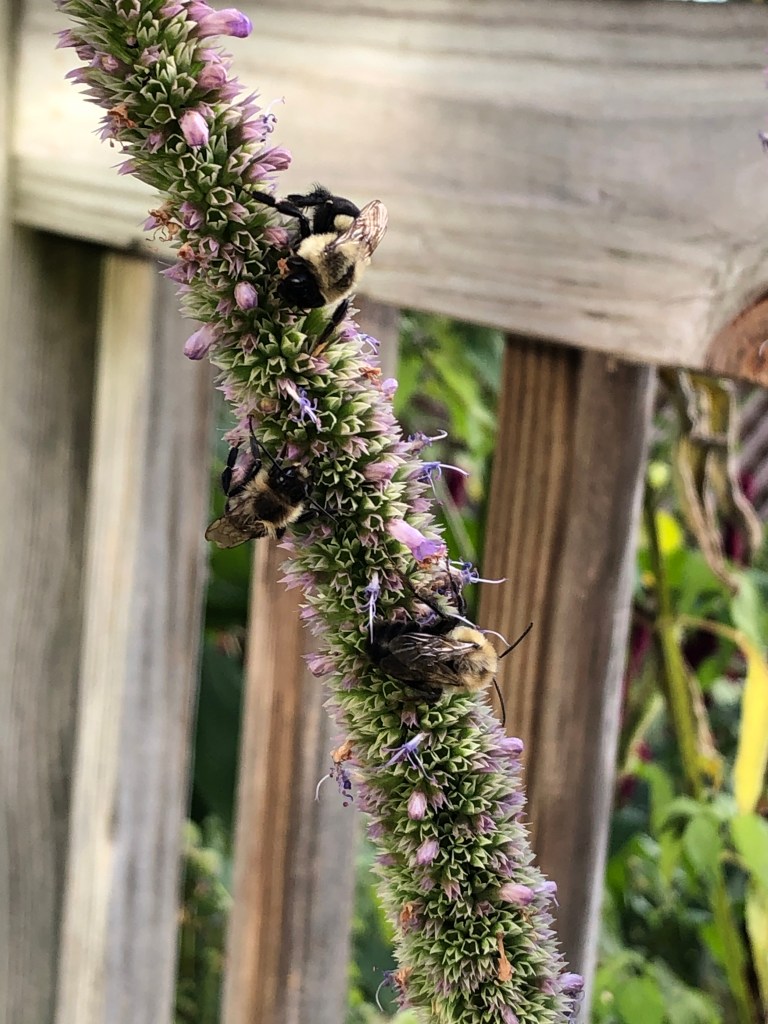
Fermented green beans – sounds delicious! So do the moon pies! I love your pretty beans in the jars. And the sweet sleeping bees. We’ve been very dry here too. We had a little rain last Sunday from the tropical depression that came from SC. I think the pattern is supposed to change as the week goes on – I hope. I hope your pattern changes too!
LikeLiked by 1 person
The fermented green beans are kind of zippy and crunchy and just a little salty from the brine. Sooo good! I hope you got some rain but not all the bad stuff from Helene!
LikeLiked by 1 person
Wow, that’s a lot of beans! I was going to make a joke about a hill of beans but decided against it, althought it did get me wondering where that odd phrase came from… Anyway, I’m glad you had rain in the growing season – in Serbia it was brutally hot and dry all summer, and I think the farmers suffered a lot.
Thanks for the recommendation of that Pocket Guide – sounds interesting, and I’ve downloaded it. Hope you don’t need it in November – I agree that it probably won’t come to that, but it does sound a lot more possible than it would have done at any other time I can remember.
LikeLiked by 1 person
Heh Andrew. You got me curious about hill of beans! According to Dictionary.com, its first usage was in the early 1860s. But according to World Wide Words, in his 1858 book JJ Thomas used it to describe how to grow lima beans. But then in the tradition of America hyperbole and the low value accorded to beans, it got turned into a phrase meaning worthless. Fascinating! https://www.worldwidewords.org/qa-hil2.html Sorry to hear about the Serbian farmers. Hot and dry while other parts of Europe had record flooding. It’s a topsy-turvy world.
I hope you find the Pocket Guide useful!
LikeLike
Thanks for looking that one up, Stefanie, and good job finding an explanation. I tried briefly and didn’t get very far. Should have known you’d find it 🙂 It’s really interesting how language evolves like this, and then we keep using the phrases without really knowing why!
LikeLiked by 1 person
Heh Andrew, curiosity and library skills for the win! 😀 Language evolution is so interesting, I agree.
LikeLike
A bar I went to once had spicy ketchup on the table, but I assumed it was normal. I about died, lol. I love that you have so many green beans. Man, some garlic, some chicken, some steamed rice, and THAT is my jam.
LikeLiked by 1 person
Tricked by ketchup! 😀 If I can sub tofu for the chicken, I will agree with you on the deliciousness of the green bean dish 🙂
LikeLiked by 1 person
Oh your beans are so beautiful! They look like glass jars of jewels. I wonder if I could grow beans in the UK? I have just bought a pot of bean pate made with onion, tomato, chilli and coriander (cilantro to you, dear friend) and it is very delicious and makes me think I could recreate it myself. We have also had a very dry August into September with the village green turning yellow. That being said, this week has made up for it and I’m looking at a large expanse the colour of a billiard table once again. I’m also catching up here after weeks out with a nasty virus (thank you for your kind wishes).
LikeLiked by 1 person
Thank you! They are kind of like jewels only I can eat them! 😀 You can definitely grow beans in the UK, they are very easy and are grown all around the world. Here cilantro is the green part of the plant and coriander is the seed used as a spice. I grew some in the garden 🙂 Your pate sounds delish! I bet you could grow all the ingredients yourself if you want to 🙂
LikeLiked by 1 person
It’s lovely to have the time at last to catch up with your news, Stefanie, and as I am missing our big French garden so much I am having to garden vicariously now! Is your dry weather normal at this time of year? It’s always a depressing moment when the rain butts run dry (no danger of that in western Shropshire at the moment, it hasn’t stopped raining since we arrived here!).
We share a passion for growing beans, they are such good food and so practical when they can be dried for storage. We harvested and dried several types to bring with us but I would say that the Majorcan pea bean is my absolute favourite. It’s an abundant cropper, the beans are very pretty and they cook much more quickly than other types with a lovely soft melting texture and great flavour. Fantastic in soup! Well worth a try if you can get the seed. I’ll add a link so you know what I’m talking about, some people call them Inca beans. https://www.beansandherbs.co.uk/product/pea-bean/
LikeLiked by 1 person
It must have been so hard to leave your big garden. When you said you were moving I got sad on your behalf! But I look forward to when you have a new garden and following along all the wonderful things you grow in it! No, it’s not normally so dry this time of year. The state drought monitor has listed us as abnormally dry and we are down a couple inches of precipitation.
I’m glad you got to take some of your beans with you for your new garden. I hope there are other things you got to take with you too. The Majorcan pea beans are gorgeous! An internet search says there are a couple places I might be able to get seed and they all call them Inca peas so I’m glad you mentioned that! Thank you!
LikeLiked by 1 person
Addendum to working with chiles and gloves: if you have arthritis, that chile oil is the Best Thing Ever! Your skin might be burning for an hour or so, but for several blissful hours after chile prep there is no joint pain whatsoever. Just got to be REALLY CAREFUL about not putting your fingers anywhere near eyes or other sensitive places.
Have you tried the Lazy Housewife? It’s a white pole bean. Extremely prolific. Also a quick pole bean. I planted my second round sometime the first got wiped out by the one-two punch of marmot-geddon and the 2nd Flooding, so sometime in mid-July, and yet had enormous plants covered in pods by early September. As a bonus the pods, sort of Romano shaped, are stringless and fleshy, very tasty.
LikeLiked by 1 person
So interesting about the arthritis and chilies! Neither of us has it, but I will stash this bit of information away in case we need it for the future! I wonder, can you make a hot chili oil to use on your hands when they hurt?
I have not heard of Lazy Housewife beans. They sound fantastic! And I have been wondering about growing a good white bean because they are kind of like the tofu of beans (I know tofu is made from soybeans but it’s not bean-beans at that point) in that they tend to take on the flavors of the things they are cooked with. Plus they can be used to make creamy sauces that don’t taste bean-y. Thanks for the recommendation!
LikeLike