
Wow, that was an intense few weeks. I know there are many comments I have not replied to; I will work on doing that in the coming days.
The garden is still busy but has begun to slow down as the days get shorter and autumn looms. I have four large freezer bags of elderberries and because they all got ripe almost at the same time while it was hot and humid and repeatedly raining, there was probably five or six freezer bags on the tree that rotted. This makes me extremely sad, but I am not able to call out from work for a week because of elderberries. If only I could though!
And apples! James is still working his way through preserving those. We have jars of apple sauce, apple butter, apple pie filling, and other jars just of apples that could be made into anything. There is one five-gallon bucket left to preserve. There would have been half of another, but thanks to two severe thunderstorms in less than 24-hours, the wind and rain took care of the apples left on the tree. On the bright side, there are no more raccoon raiders throwing apples on my bedroom roof at 4 in the morning! Thankfully the trees in my garden made it through the storms (there was a third severe storm four days later) unlike some of my neighbor’s trees, one of which fell down across the entire street and landed on the hood of someone’s car. It was rather disconcerting the morning after the double storms to walk my bike out to the street, look up to see the street completely blocked three houses away, then walk my bike back to the sidewalk where I was able to ride past the obstruction. Losing the rest of my apples was nothing in comparison to that!
Every evening after dinner I go out into the garden with a bowl to pick green beans and tomatoes. We’ve had so many tomatoes this year! The Hungarian Heart tomatoes are for sauce and they are as big as a heart. Only four or five tomatoes on a plant but when they weigh over a pound each, they make up for the few in number. I’ve saved seeds from the vine that grew the largest tomatoes to plant again next year. The plum tomatoes, grappoli d’inverno, are sweet and prolific, and when roasted make a marvelous sauce. They are also delicious cooked up into various dishes. I have saved seeds to grow more of these next year too.
James really wanted a black tomato and I found a small slicing variety the name of which I don’t remember, mostly because it has been a disappointment. It just began getting ripe two weeks ago and they are not even close to being black like in the photos, more like a brownish-red. The vines are not at all prolific and the flavor is fine but not amazing. I have not saved seeds and will not be growing this one again.
The random tomato plant I found growing in a crack in the alley in June and transplanted into the garden turned out to be a true cherry tomato. The vine is pretty sturdy, moderately prolific, the tomatoes the size of large marbles, and the flavor is barely sweet and sort of earthy. Since they are small you can put a whole one in your mouth and it makes a satisfying pop when you bite into it. I have saved seeds to grow more next year but have no idea what this variety is so have dubbed it “Alley Tomato.”
Besides eating tomatoes in dinner almost every night, James has also made several quarts of sauce both sweet and spicy, a couple quarts of tomato soup, and we are fermenting a bunch of the grappoli tomatoes in a two liter glass crock. There are still quite a few tomatoes waiting to be used and a bunch still on the vines, so James is keeping busy! Why we haven’t made salsa yet, I’m not sure. Perhaps that will be next.
As for the beans, we have so many! We have four quarts of them fermenting on the countertop and a large bag in the freezer. The vines will likely keep producing until they are killed by frost sometime in October.

You may remember the battle between me and the squirrels over zucchini seeds earlier in the spring. Every time I planted zucchini seeds a squirrel would dig them up and eat them. I planted and protected a whole bunch towards the end of June and they all sprang up and I had hope. In spite of the gardening hive mind saying it was not too late, it was too late. Even though they sprouted and grew, it is just now that one of them has a tiny squash on it. While it is still warm, the days are shorter and I doubt this tiny squash will get big enough to eat.
However, one of the yellow zucchini seeds (variety “goldini”) from the first planting in May did escape squirrel detection and got a zucchini on it. Because it was the only one, I decided to leave it grow to full size so I could save seeds and try again next year. That means the zucchini weighed about five pounds when I finally picked it the other day. Aside from saving seeds, James will be turning it into bread and probably relish.
It is my second year trying to grow sweet meat and turtle moon winter squash and once again neither of them did well. They had a good start but by the end of July the vines were dead. I will not be trying these a third time. The naked pumpkin out in the chicken garden protected by wire mesh is doing pretty well and has a couple of small pumpkins on it. The naked part is the seeds, they are pepitas, and, uncommonly, the flesh is supposed to be good to eat too. We’ll see.
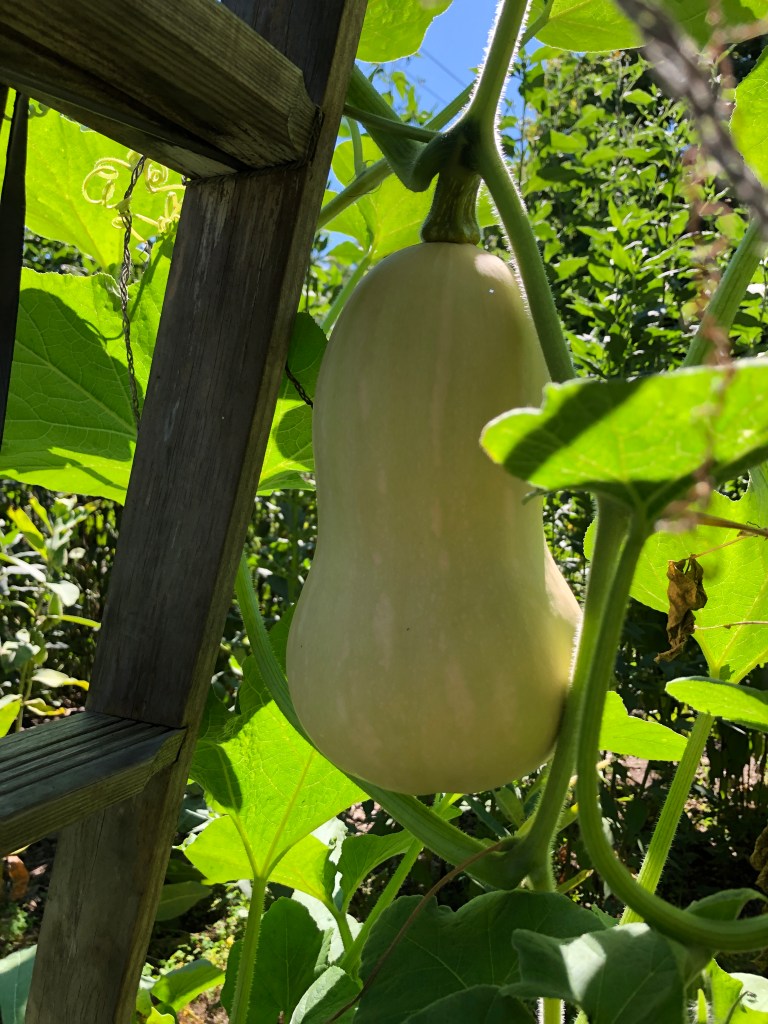
The butternut squash vines growing up the ladder are doing beautifully. I have five squashes of various sizes, one of them is close to being ripe. So exciting! Growing them up a ladder has worked out so well I plan to do it again next year.
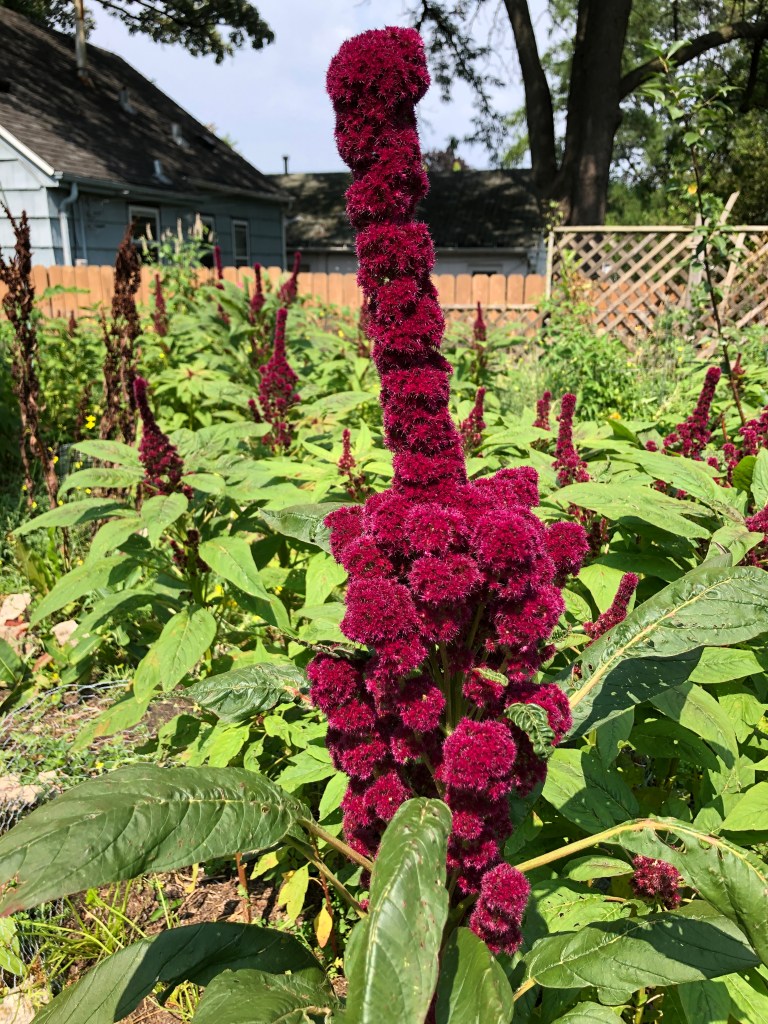
One of the strangest plants in the garden that has pretty much gotten to the point of continuously reseeding itself is the amaranth. When the plants are small the leaves make a tasty salad green. When a bit larger they can be cooked and used like spinach. When the plant gets full size and blooms, the leaves aren’t very tasty any longer. The flower seeds are considered a grain and I’ve tried to harvest and use them before but the seeds are so tiny—like poppy seeds—and take so much work to clean them from the chaff that I quickly gave up. Even though the flowers don’t attract bees or butterflies I still like them because, well I call them the “eff you” plants, and I laugh when I look out at them because it’s like the entire garden is flipping me off.
In the spring I was so worried because there were hardly any bees in the garden. Word must have gotten out, because now the entire garden is buzzing. The hyssop, both white and purple, has spread itself around the edges of the deck and grown up tall and is covered with bees. James and I are perpetually delighted to walk out in the early morning when it is dewy and cool, to see big bumble bees sleeping on the flowers or tucked in beneath a leaf. When the sun reaches them and they begin to warm up, they meticulous wash their heads and faces with their front legs, cleaning off the dust and damp. And then they get busy with their hyssop breakfast.
The hyssops at this part of the season are beginning to go to seed. The goldfinches have found them, so now, along with the bees, I look out and see little birds bobbing on the flowers, filling up before continuing on their flight south.
And the water dishes on the deck, they are not just the local drinking fountain for all the various critters from insects, to birds, to squirrels, chipmunks, and raccoons, but they have become the public pool for the sparrows, especially the fledglings. Watching the young birds learn how to bathe has been a joy. Once they figure it out, bathing becomes play and they jump in and out of the water, splashing and chirping, sometimes shoving another out of the way, sometimes arguing over whose turn it is next. Their parents sit nearby and keep an eye on them. And when they have splashed all the water out of the pools, they line up on the deck rail to fluff and dry their feathers and preen them back into place. After they have flown off, I refill the water and the parents come back, a more sedate bunch, have a drink and their own little splash. Their obvious pleasure is infectious, and I don’t think I will ever get bored watching them enjoy themselves.
Reading
- Book: It Can’t Happen Here by Sinclair Lewis. The story begins in 1936 with a presidential election that sees populist Buzz Windrip into the Oval Office. Very quickly he becomes a fascist dictator, removing the Supreme Court and turning Congress into a body that can no longer introduce and pass their own legislation as well as abolishing all but his own political party. It goes from bad to worse with no trial by jury, false imprisonment of people who disagree and outright murder on accusations of made up charges. The prisons get so full, concentration camps are opened across the country. An underground resistance works to get the truth of what is actually happening out. Eventually, the fascist government starts eating its own, and Windrip’s second in command takes over in a coup. As the resistance grows, the government needs to take more extreme actions to distract everyone and so begins a war with Mexico. The book, to its credit, doesn’t end with any kind of solution or new democratic government. There are a group of counties in Minnesota that declare themselves independent of the country and manage to hold off the fascist militia. And that’s where it ends. It’s not the most literary of books, it was written over the course of only a few months, and there are some teething-grinding passages in which Sissy, one of the main characters thinks that being raped wouldn’t be so bad and is a little curious about what it might be like. There is another passage that rails against anti-semitism while at the same time being steeped in Jewish stereotypes about money and bankers. But it makes some astute observations about how fascism in the United States is going to look completely different than it does in Europe and other places. And Lewis suggests that everyone is complicit, especially those of us who are anti-fascist but dither and disbelieve because we think it can’t happen here, thus allowing it to happen.
- Book: The Seed Detective by Adam Alexander. An interesting look at where some of our common vegetables come from. For instance, did you know squash has been around for 10,000+ years but the first zucchini wasn’t described until 1901? Another interesting tidbit: Romans believed that after death our souls take up home in (fava) beans, which made them an essential part of a funeral feast. But this made me wonder, if our souls find a home in beans, why would you eat them when you could be eating someone’s soul? Alexander writes that the diversity of seeds and vegetables used to be astonishing with people growing locally adapted varieties in one town that no one grew 50 miles away. Because of the globalization of food and agriculture we have lost about 90% of all varieties of fruit and vegetables in the last century. Alexander writes, “The triumph of quantity over quality has resulted in us eating food of poorer nutritional value than that enjoyed by our parents and grandparents. Despite modern cultivars of popular vegetables being more vigorous, having heavier yields and greater disease resistance, my taste buds tell me they usually have less flavour. We have become used to buying and eating food that is unripe and tasteless, despite what marketeers might say to the contrary” (pg. 268).
- Book: Mina’s Matchbox by Yoko Ogawa, translated by Stephen Snyder. A quiet story told by Tomoko who was twelve in 1972 when she went to live with her aunt’s family for a year while her mother completed a course in dressmaking in Tokyo. Mina’s father has recently died and they don’t have much money, so when Tomoko arrives at her aunt’s house in Ashiya she is taken aback by the wealth and grandeur on display. Her uncle is the owner of a soft drink company started by his grandfather. Also in the house is Grandmother Rosa (her uncle’s mother) who we eventually learn is Jewish, was born and raised in Germany and left for Japan just before WWII, and whose twin sister and family were all killed in concentration camps; Yoneda-san, the devoted servant as old as Grandmother Rosa who has become a sort of substitute twin sister; and the precocious Mina, the asthmatic thirteen-year-old daughter of her aunt and uncle who rides to school every day on the back of a pygmy hippo, the last remaining animal from the zoo created by her uncle’s grandfather. Of course Tomoko discovers there is more going on in the family than one might suspect.
- Book: Knife by Salman Rushdie. Very much a cathartic telling of the knife attack and Rushdie’s recovery from it. As emotional as the story clearly is, the tone of the book is curiously even and emotionally contained and only hints at the depths behind it. Rushdie is trying to work out the whys of the event and to come to terms with the loss of his eye and much of the use of his left hand. What I found most curious, however, was how Rushdie describes his near idyllic happiness with his wife of five years and how the knife attack has ruined it. He says they are still happy in love but because of the attack there is now a sort of dark corner or shadow in their happiness. Rushdie was 75 when he was attacked and I find it interesting that he somehow thinks married happiness should always be like a sort of blissful honeymoon. Neither life nor marriage is like that. The attack was horrific and traumatizing and no one should have an experience like that, but to say it has marred his perfect happiness? Every marriage has small and large challenges that he got five years without any is pretty amazing. This is not a groundbreaking memoir by any means, but it is good to get the complete story. His assailant will finally by going on trial September 9th.
Quote
“If you are afraid of the consequences of what you say, then you are not free”
~Salman Rushdie, Knife, page 99
Listening
- Podcast: We Are the Great Turning with Joanna Macy and Jessica Serrante. Macy is 95-years-old, an activist, scholar, expert in systems thinking and deep ecology as well as a Buddhist. She has been writing books and working on climate issues for several decades. If you have not read her book, Active Hope, I highly recommend it. Jess is 35, an activist, facilitator, and trainer who has been working in the climate movement since 2007. Each episode is 30 minutes or less and it’s just Joanna and Jess talking about how to stay joyful and present in a world full of crises. I’ve listened to seven of the ten episodes and end up crying at some point in almost every one. Sometimes they are tears of grief, sometimes joy, and sometimes relief over hearing other people putting words to feelings and thoughts I have also had.
Watching
- Movie: The Boy and the Heron. A beautifully animated story in which Mahito must come to terms with the death of his mother and decide whether to live in the “real world” or an alternate dreamlike world that has to be recreated daily that his grandfather wishes him to take charge of. It’s strange but compelling.
James’s Kitchen Wizardry
See above for all the wizarding James has been doing. In terms of meals, here is one we had recently, walnut beet burgers with zucchini relish (zucchini came from the farmer’s market), tomato, and avocado on a homemade bun with some delicious grapes on the side.


What a bounty! I read all of your post and now I’m quite hungry, especially finishing with the burger picture, yummy!! At the end of summer I always find that the abundance of tomatoes leaves me with no imagination on how (else) to eat them, it’s a pity but they are at their peak taste yet my family gets fed up with them. I seem to be always rotating between stuffed tomatoes in oven, or used in salads, or with mozzarella. Any suggestions from your side?
I want to see if my library has this Yogo Ogawa book and also try the podcast you recommend.
My sons loved the Boy and the Heron, I’m glad you did!
LikeLiked by 1 person
I’d say turn your excess tomatoes into sauce or soup and then put it in the freezer to enjoy in winter. Or you could make salsa or tomato jam or chutney all of which could also be frozen to eat later. You could make tomato cake https://www.almanac.com/recipe/fresh-tomato-cake-cream-cheese-frosting We plan on rewriting this to a vegan recipe but haven’t yet so I don’t know what the cake tastes like but I’m intrigued! There are also lots of Indian dishes that call for tomatoes. so much you can do 🙂
The Boy and the Heron was surreal at times, but quite enjoyable 🙂
Enjoy the Ogawa book and the podcast!
LikeLiked by 1 person
I listened to Knife earlier this year and also found his delivery fairly even except the occasional slight change in his affect that revealed he was being sarcastic. I also found the stuff about his wife interesting, but I think what he was saying is there was so much focus on him and his mental health and his PTSD and his return to normalcy that the focus on his wife and their relationship diminished. I think they’ll come out the other side just fine. I’m curious about how they are different now that he is healed enough that he wrote this book, which I’m hoping was cathartic.
You say that you love watching the baby birds play in the water. If your library has an audio copy of the book The Bird Way by Jennifer Ackerman, you would enjoy it. It talks about the why and how of birds playing, in addition to how they parent and work and other elements of being birds. Right now, my mom is starting to get nervous about her upcoming retirement at the end of the year. One of her concerns is that she and my dad have grown used to feeling content sitting on their front porch and watching the birds on the bird feeder. I tried to tell her that she’s hit the sweet spot of life, but she’s had jobs that are traumatizing and fast-paced, so I understand why she’s concerned.
LikeLiked by 1 person
That must have been interesting hearing him read the book! Thanks for your perspective! I think they have managed to come through it all too. Yes, it would be interesting to know how they are different now, after the book and the documentary. I think it will also be interesting to see if his next novel departs at all from previous styles and themes.
Thanks for the tip about The Bird Way! I will check to see if my library has it. I hope your mom’s concerns over retirement ease and she can look forward to it and enjoy her new freedom.
LikeLiked by 1 person
Love the descriptions of your garden. That burger looks delicious and it’s also a feast for the eyes.
I couldn’t read that Sinclair Lewis book right now. I won’t watch the debate tomorrow but hope that Mr Senile Dementia will reveal how old and addled he is and more of the news people will stop making excuses for him.
I had covid at the end of July and the weirdest thing about it is that it destroyed my enjoyment of tomatoes, just at the time they were starting to be good. I hope my taste for tomatoes will come back eventually.
LikeLiked by 1 person
Thanks Jeanne!
I refused to watch the debate because I knew I would only end up yelling angrily at the orange menace. The Sinclair Lewis book was hard to read in light of our current situation, but I’m glad I read it. It put our current moment into a clearer historical context–we’ve been here before. I think though that Roth’s book, Plot Against America is better written overall, but somewhat easier to dismiss because it’s an alternate history. While Lewis does include real people in his book, it feel more personal and possible in a way that Roth’s book doesn’t.
I hope you recover your taste for tomatoes!
LikeLiked by 1 person
Joanna Macy is awesome! We just got our first spaghetti squash in the CSA: we had the first (and last) melon two weeks ago. Do you guys have that organization of volunteers in the city that rotates through members’ gardens when/as needed to pick in times of abundance and a portion of the picked produce goes to food security groups locally? That might be a literal saver for you next year, thinking of your berries. But, also, on the other hand, hopefully some of those berries were enjoyed by your bathers too. Ohhhh, how I love watching the bathers. Such a genuine joy. We’ve had a fledgling blue jays for the second time this year, who have been star water-babies. Are you awaiting Kimmerer’s new book on serviceberries?
LikeLiked by 1 person
Yay for Macy! Yay for spaghetti squash!
I know which organization you are talking about and I don’t think we have them here. If we do, I doubt they would be interested in elderberries because they don’t keep longer than a day once picked and they have to be cooked because they are toxic when raw and will make you sick. The chickens can eat them raw, however, and they enjoyed more than they usually get, as did the sparrows, so it wasn’t all wasted 🙂 Your fledging blue jays must be a delight!
I am very much looking forward to Kimmerer’s new book!
LikeLike
Your garden stories always leave me in awe and then James is just such a kitchen God. It seems Summer has been mostly good, though the Strom…omg! How very unfortunate! Matchbox sounds very intriguing….will look it up! Wishing you both a happy serene Autumn
LikeLike
Summer has been great and we were fortunate at our house with the storms. James is indeed a kitchen god! I’m so happy you enjoy my garden stories. Thanks for the autumn wishes! I hope you are doing well and have a lovely autumn too!
LikeLiked by 1 person
Raccoons throwing apples! F U plants! Giant zucchini! I love this post. So many interesting tidbits. I love the story of the ally tomato. You are making me want to try growing something that is food again. I’m glad that you didn’t have much storm damage. It has been VERY dry here for weeks. But the bees and butterflies are still loving all my flowers and I love to watch them. I did not know that zucchini was such a new plant! Thank you for always teaching me things.
LikeLike
*alley* tomato lol
LikeLike
It’s been quite the gardening season this year Laila! If there are any seeds you want from those I am saving, let me know. I am happy to share! I was surprised to learn how new zucchinis are too. They are a variety of pumpkin, which I did know–if you grow zucchini and pumpkin too close together, they will cross. I had that happen once and it was interesting. Enjoy your flowers and bees and butterflies!
LikeLiked by 1 person
The F-K you plant!!! Hahahahahahahaha -that did make me laugh!
Also, I’m coming to dinner at yours to eat some of those tomato dishes you’ve been making. They sound so scrummy. There’s nothing like roasted tomatoes fresh off the vine.
Very interested in your review of the Salman Rushdie as I picked up a 99p kindle copy of it about a week ago. I wondered how it would be and your review gives me an excellent idea. I’m intrigued, but now my expectations are set at a reasonable level, I think.
Finally – hyssop! Our garden has been totally wrecked by building work and next year we’ll start to remake it and I do want it to be a haven for bees. Hyssop will definitely be in the planting – thank you for the tip!
LikeLiked by 1 person
I’m so glad you got a laugh! 😀
You are welcome to dinner any time!
Oh, I look forward to hearing what you think of Rushdie’s book.
Hyssop is an amazing plant. Now that the bees are almost done with it I have goldfinches and chickadees visiting it to eat the seeds.
LikeLiked by 1 person