Here I went and had another unintentional blog-cation.
We’ve been having second summer for weeks with temperatures as much as 20 degrees F above normal, whatever normal means these days. Yesterday, Saturday, was a record high of 91F/ 33C. I am grateful that today is cooler and we are getting a cold front—finally—that will tip us into more seasonal, if still a bit above average, temperatures.
This means the garden is still going, not that it is going gangbusters like in July, but every evening I go out and pick green beans and tomatoes, sometimes a newly ripe pepper or tomatillo or radish. There are a lot of carrots to pull, but I am waiting for when James is ready to make carrot soup from the roots and pesto from the tops. It has also been dry, no rain for a couple of weeks, so James and I have had to water. Our rain barrels were thankfully full to overflowing and we have yet to drain them, but we water by hand, carrying watering cans around to all the thirsty plants, and this takes time.
I still need to finish pruning the raspberries of this year’s canes. I did give the plum and bush cherries a light trim. I am still picking pod beans—so many! This is what I’ve been doing on my Sunday afternoons instead of writing a blog—shelling dry beans.
The skunk beans did amazing this year. So did the Hidasta red beans. The succotash beans didn’t do great last year so I tried them again this year. Last year was the first year I had grown them and they are pretty purple beans that look like corn kernels. This time around the vines grew tall and lush, but for all that, produced not even a pint jar of beans. I’ve decided I won’t be growing them again.
The brown resilient beans, a mixed genetic variety of bush bean developed by Carol Deppe, gave me a huge surprise. I have ben growing them for four years now and they have been scrawny but productive bush beans that survived drought and multiple rabbit attacks, living up to their resilient name. Each year as I grow them on, it has been fun to see the beans change color. Originally a medium brown, I still got plenty of those, but also started getting tan, mottled brown, white, and black beans. Well this year most of them decided to become pole beans!
Their decision to become pole beans created a bit of wild jungle because I didn’t trellis them since they are supposed to be bush beans. The vines scrambled everywhere including wrapping themselves around and through several tomato cages and tomato plants. They climbed milkweed and sunflowers. They eventually found their way to the skunk bean and cucumber trellis where they grew so vigorously, they snapped the maple stakes I had made from branches dropped by the silver maple in the front yard. I came close to ripping the mess out in frustration until I noticed how many bean pods were on these vines, and not little pods like on their former bush bean incarnation, but long fat pods.
Now that I am able to pick them, the beans inside are pinto bean sized, and are a pretty light tan mottled with a medium brown. When they are all picked and shelled, I will likely have a quart or more from perhaps 12 plants. I am saving the biggest, fattest of these newly minted pole beans to plant next year. I am not saving any seeds from the ones that retained their bush habit because those didn’t produce all that many beans. It’s possible the bushes were overwhelmed by their aggressive siblings, but I have decided the very productive pole bean development is what I want to plant on and see what happens next year. Watch them revert to bush beans, wouldn’t that be a hoot? (The answer is no).
Every year I like to try to grow a few new-to-the-garden plants. Since I can’t grow corn because the squirrels and raccoons demolish it and rudely leave nothing for me, I thought I would try sorghum. I got a variety that is good for both syrup from the stalk and grain from the flower heads. Sorghum is a grass that looks just like a cornstalk, but the seeds don’t grow on a cob. The seeds don’t need any special processing other than winnowing, and they are big enough that this task would be easy.
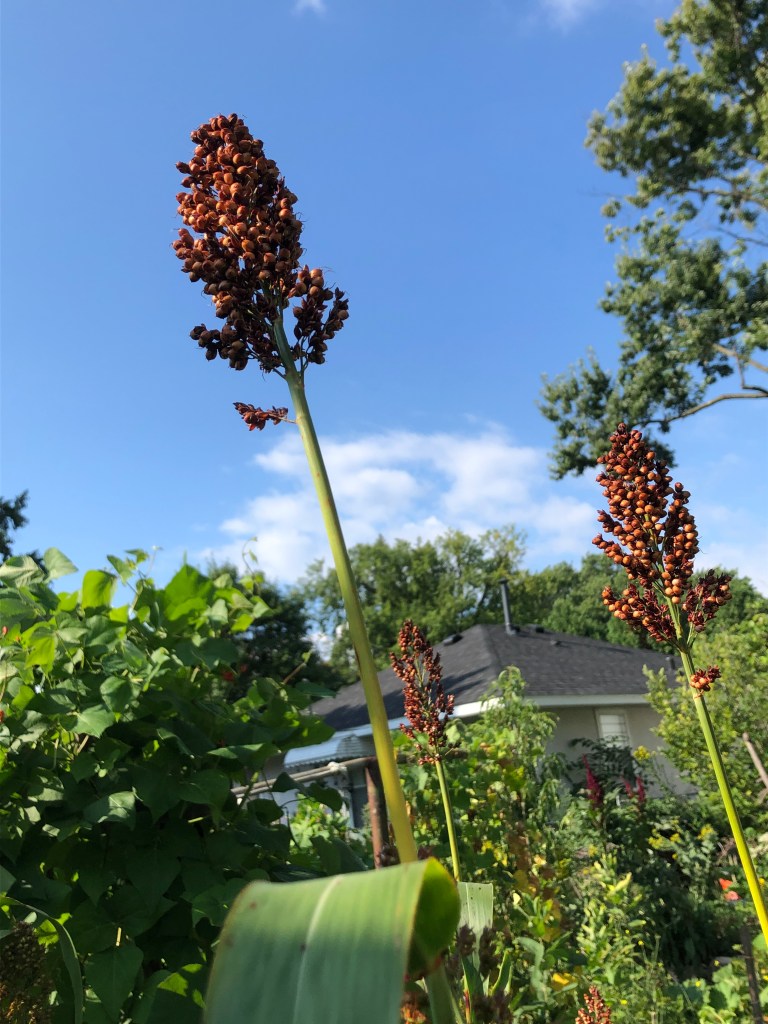
I planted 15 seeds, enough, I figured, for James and I to have sorghum cereal for breakfast a couple times. They all came up and flowered. To harvest, I needed to wait until the seeds were hard enough that I couldn’t dent them with my fingernail. I waited and waited, tested and tested. And then birds ate every last seed before they were completely ripe!
I could make syrup from the stalks at least. Only when I looked up how to do it I learned I needed a roller press like a wash mangle. And then the plant liquid needs to boiled. And boiled. And boiled some more like when making maple syrup to bring out the sweet and remove a lot of the liquid to make it thick and syrupy. I might end up with a tablespoon of syrup from my 15 stalks. Too much work for not much. Needless to say, syrup is not going to happen.
There will be no more sorghum growing.
James did promise to help me, however, harvest the amaranth seeds. Amaranth seeds are so tiny that the one time I tried to harvest them for food, It took me hours to separate the chaff for what seemed like a very small return. But given the sorghum fail, I looked up more information on harvesting amaranth, and with the help of James and a fan I think we might be able to make a good enough harvest from the randomly growing self-seeded plants around the garden. I’ll let you know! If it works out, I might make a go of purposely planting some next year. Neither birds nor squirrels are interested in them, so maybe…
I can happily report that plum-sour cherry jam is delicious! It makes a pink jam that at first glance might make a person wonder, but the taste—yum! I can also happily report that plum-elderberry jam is delicious. This jam is dark purple, though a bit lighter than straight up elderberry, and the plums compliment the more astringent elderberry quite nicely without any added sugar. It makes for a mild, somewhat earthy-flavored jam. We will definitely make more of both next year.
In addition to the garden and the usual everyday of work and life, James and I have been attending a weekly Beloved Community Circle cohort training. There are ten people from our sangha who decided we wanted to practice the engaged part of our engaged Buddhist tradition, and so formed a Beloved Community Circle. We’ve been meeting once a month since May, getting to know each other, building our relationships, deeply sharing and listening.
When the organization that provides training and support for Beloved Community Circles announced they were doing a 9-week training, James and I signed up. So far there have been five Zoom training meetings and I have learned so much about community building from each one. I am taking detailed notes and sharing them with my own Circle because James and I were the only ones who were able to make the commitment for the training.
What is a Beloved Community Circle, you ask? In case you don’t want to click through to find out more information, it is, in brief, a close-knit group working in community towards climate and racial justice, grounded in nonviolence, emotional healing, spiritual practice, and mindful action. There are Circles all a round the world. There are about 50 people in the training court from across the United States and the world. Some, like James and I, are members of new Circles, others are taking the training in order to start Circles in their area.
Creating a close-knit community like this is challenging and rewarding work. My Circle is wonderfully diverse in age, gender, background, ethnicity, and class. We have not done any group actions yet; we are still in the building phase which is engaged action all on it’s own given how individualistic and divided the U.S. and the world is these days. Not surprisingly, most of us have a deep interest in care taking/ protecting people/living beings. I personally want to do care taking work within the area of building alternatives, but we’ll see what eventually arises from the group.

I’ve also been doing lots of reading and listening and hope to share some of that with you next week. In the meantime, take care of yourselves and enjoy a little music from a wild mushroom. Apparently mushroom music is a thing!

How wonderful about the circles. I recently completed a two year training program for teaching mindfulness meditation. These circles sound wonderful, I’ll read more. Thank you! And loved the garden update. I just picked some green beens too from our garden, probably the last of them.
LikeLiked by 1 person
How fantastic you completed a 2-year training program for teaching mindfulness meditation! The whole circle thing is pretty fantastic and, while based in Buddhist ethics, is open to all faith traditions. I hope you thoroughly enjoyed those green beans from your garden!
LikeLiked by 1 person
Omigawd! The mushroom music is awesome!!
LikeLiked by 1 person
Who knew mushrooms had such musical talent!
LikeLike
People come visit my blog and tell me they don’t read horror, and then here I am, on your lovely major blog, and you creep me out with a jacked up mushroom putting out weird little tunes. 🤣 I like the idea of your circle and doing community action. As I’ve mentioned before, one of the reasons I’m not big on protests is because people are often protesting something that they’re protest isn’t going to change. For instance, if you and your friends get together and tug around a giant balloon that looks like Donald Trump wearing a diaper, you’ve definitely spent an afternoon on the weekend doing something, but doing what exactly.
LikeLiked by 1 person
Hahahaha Melanie! The mushroom music is kinda creepy in a way, but also totally amazing 🙂
I know you aren’t big into protests, but they do play an important role in creating a visible resistance which can help people who think no one else feels/thinks the same way as they do. They also provide emotional release and solidarity. Alone they are not likely to change things, but in combination with other actions, most definitely they make a contribution.
LikeLiked by 1 person
I like the sounds of Beloved Community Circles; it reminds me of the All You Can Save groups which have training sessions that are similar. However, the work gets done, that’s the way: I’m sure your group will appreciate that both you and James have taken the official training, it can be hard to schedule to suit diverse attendees.
Of course your public actions don’t always need to be protests, but I think they serve a vital purpose from a social perspective. They might not change the lives of individual participants or observers very much in the immediate, but those of us who live in relatively free societies (or have done, until, ahem, recently) recognise the importance of protecting the right to free speech and peaceful demonstration as building-blocks of democracy (even if our democracies are not perfect).
Amaranth is SO tiny, OhEmmGee, I could never! And I’ve only made plum jam once (just a small amount of plums to be had) but it was one of my fave jams ever. Was the sorghum hard to grow (like my failed chives?) or does it mostly fend for itself with watering? I would like to plant some for our birds (their sunflowers didn’t come up this year at all /sigh).
LikeLiked by 1 person
I love that there are so many ways to build communities of engagement, something for everyone!
Agree with you Marcie regarding protests.
The tininess of amaranth is what made me give up trying to harvest it years ago and just enjoying the early leaves in salads the funny flowers. But if James actually helps me, I might actually make a harvest. Of course since the seeds are so tiny it ill probably still end up being a lot of work for not much payoff!
We had some plain plum jam too and I agree, soo very good!
Sorghum is super easy to grow. It likes it hot, the humidity doesn’t seem to bother it, and it is drought tolerant so other than when the seeds were germinating and just sprouting I never once watered it. It looks like grass when it sprouts though and I came very close to pulling it all out thinking it was weeds. Since I had planted it in four short rows though, I figured out it was sorghum before I made a regrettable mistake 😀
LikeLike
Sorry to hear about the sorghum, although I do like the idea of those birds having the blowout sorghum feast of their lives 🙂 Amaranth sounds like a good option – I’ve cooked it from time to time and enjoyed it, so hope the harvesting is not too fiddly.
I love the idea of the Beloved Community Circle! Look forward to reading more about how that works in future posts.
33 in Minnesota in October? Yikes!
LikeLiked by 1 person
Until the birds ate all the sorghum I was thinking I might try millet next year, but I tossed that idea out pretty quick! 😀 I’m still waiting for the amaranth flowers to dry before I try to harvest the seeds. At least I don’t have to worry about the birds eating it!
One of the things I am enjoying about the Beloved Community Circle training is all the people from all over who are working to make the world better. Little by little we will make a change!
It was ridiculously hot! And then a few days later we came within a couple degrees of having frost. But at least it didn’t suddenly decide to snow!
LikeLiked by 1 person
You’ve got me thinking. I read your garden posts and always think, “Wow, that sounds like so much work.” And today I realized that this was how people ate food and survived for millennia – hard work! Planting things! Seeing what worked and what didn’t. Waiting for rain and guarding against rabbits and whatnot eating their food. And now we just go to the store or the restaurant and buy it. No wonder we are so disconnected from seasons and the earth. But everything about modern life stacks the deck against people having time to garden for food – unless you are really intentional about it. This all seems obvious but it’s like the lightbulb just lit up for me, ha ha. Anyway, I admire what you do and you also work full time! So it can be done. Thanks for sharing your experiences.
LikeLiked by 1 person
I am familiar with that lightbulb moment Laila! I had it way back when I began expanding the garden from a 6 x 4 foot bed. But I also discovered that it is good rewarding work in so very many ways. I think we’ve been bamboozled by capitalism into to thinking growing food is a drudgery we should aim to escape. It is so much better working in the garden than sitting indoors all day. When you find work you love, even if it doesn’t earn a salary, you find a way to fit it into life 🙂
LikeLiked by 1 person
Mushrooms are uncanny!
I’ve been reading books to my 8 month old grandson and playing with the toys marketed to under-ones and marveling at how much of it is aimed at identifying farm animals. I wonder if this is (like school summer breaks) a vestige left over from an agricultural past?
LikeLike
Aren’t the mushrooms amazing? Maybe you can figure out a way to play your violin accompanied by mushrooms 🙂
An interesting observation about farm animals in children’s books. I had never thought about it before but you are right. And it’s not just farm animals. Too bad adults don’t get too many books with animals.
LikeLiked by 1 person
I feel a bit sad for Sorghum that you have rejected it! I would hate to be rejected by you!! Then again, I probably would not try to play so hard to get.
I have never heard of Beloved Community Circles, and loved reading about it and your and James commitment to finding ways to make life more meaningful.
LikeLiked by 1 person
Don’t feel bad for the sorghum, I wouldn’t have rejected it at all if the birds hadn’t eaten it! Critters get enough from the garden as it is and there is no room to grow things just for them.
We finished the Beloved Community Circle training and it was really wonderful. Now we are sharing all we’ve learned with our local circle so we can put it into practice and it’s already starting to sprout new ideas for everyone. Yay!
LikeLike