It’s plastic-free July! Have you checked in on your plastic usage lately? James and I haven’t made it to the Asian market yet to search out tofu making equipment, but we did eliminate a different big plastic item from near daily use: bike water bottles. Or if you want to get fancy and French because le Tour is currently on, bidons.
We have quite an accumulation of bike bottles from the years and they are all plastic. The pull tops have slowly been going bad and either leak water whenever I hit a bump in the road or the whole top pulls off when I try to raise the cap for a drink. The bottles themselves are just fine so we’ve asked at various bike shops and searched and searched online for replacement tops. But no. Everyone wants you to buy an entire bottle. Wouldn’t it be great if we could get bottles that weren’t plastic at all?
Now we can! And we did! James found a new small company in Vermont called Bivo. They make stainless steel bike water bottles that fit in the bottle cages on bikes. They are dishwasher safe, and easy to clean, and drink from, the tops are made from food grade silicone. And, if the drinking top breaks, you can get replacement pieces. No plastic! Less waste! And, after the initial investment, saves money!
We bought several and have been using them for a couple weeks now, and love them. They do rattle a little sometimes and it freaked me out the first ride I had with one because I thought something was wrong with my bike. Once I knew what the occasional rattle was, it was no big deal. So if you are a cyclist and looking to go plastic free with your water bottles, check out Bivo!
Let’s Talk About the Weather
What a weather week it was. We had “pop up” thunderstorms almost every afternoon. I was lucky enough for the rain to be done before I left work, or not begin until after I got home. I feel like I should have bought a lottery ticket or something, but decided no, that would completely ruin my luck. Because on Wednesday I was incredibly lucky!
Around 3:15 I looked up from my desk at work to notice how dark it had gotten outside. Within minutes it was pouring rain. Not just a regular downpour, but a deluge. The streets started flooding because the water couldn’t run off fast enough. And the street hole covers turned into fountains gushing water a couple feet into the air. The wind was blowing from different directions and I watched as rain would slant down from one direction and meet rain coming down from another direction and they’d meet and turn into this swirling mass of water. I have never seen anything like it.
I thought there was no way I’d be able to bike home at 4. But by the time I had changed clothes and was ready to leave at 4:10, the skies were clearing and there was hardly a sprinkle. Later I found out we had gotten 2 inches/5 cm of rain in 45 minutes! The meteorologists called the storm a “rain bomb.” If you scroll down the page you can see a slow motion rain bomb video and see exactly how it got the name. Polar vortex, heat dome, wet bulb temperature, and now rain bomb. My climate change weather vocabulary is growing. I wish it weren’t.
At the beginning of the weekend we were under an excessive heat warning for both days. But Saturday morning and afternoon some rain blew in and kept the temperatures cooler and overnight Saturday we had a rousing thunderstorm. Today, Sunday, is sticky humid but the excessive heat warning has been dropped. I am really glad for that since high temperatures really would have made today dangerous. Instead it is just really uncomfortable.
And the Garden and Chickens
All this rain and warmth has turned the garden in to a jungle and the humidity makes it feel like one too. Poor James can’t go outside without covering all his skin because the mosquitos are so bad and he gets welts from their bites. Wading through the garden Friday to pick greens and beans for dinner, I found a milkweed that is as tall as my shoulders. Granted, I’m not exactly gifted in the height department, but I didn’t know milkweed could even get that tall! And plants like pole beans, sunchokes, nettles, and sochan that already get tall are soaring to surprising heights. I don’t generally feel small in the garden, but this year I feel like a short garden gnome.
Between the rain and the warm humidity I’ve not been able to spend time in the garden lately except to pick the last of the peas, the last of the raspberries, the last of the gooseberries, and the start of the green beans. Also, lettuce, arugula, amaranth, and lambs quarters for salad greens. Fennel, marjoram, summer savory, cilantro, and tulsi basil for herbs. The jalapeño peppers are almost ready to start picking and it won’t be long until I am picking cherry tomatoes. The various winter squashes are starting to vine and will hopefully start getting a squash or two. The summer squash, having gotten such a late start due to the squirrel battle, are getting close to being big enough to flower. Perhaps by the end of the month I will have a few tiny zucchini and crooknecks.
The elderberry somehow continues to expand. When we let the chickens out of their run they take two steps and and disappear beneath it. Just as well, it keeps them cool and safe from aerial predators. It doesn’t keep them safe from each other though.

Since Elinor and Lucy’s demise, Sia has become top chicken and Ethel is the bottom. Sia is not a kind ruler. She frequently chases Ethel around and pulls out her feathers. Poor Ethel is probably wishing Elinor was back, because, while Ethel was terrified of Elinor, Elinor at least just chased her or gave her a peck and never pulled out her feathers. We are surprised that behind Sia’s goofy appearance and her inability to see all that well is a rather mean chicken. Mrs. Dashwood, being old and former top chicken, still gets respect and no one messes with her. She is living her best life right now with all the regard and none of the responsibility.
Fun with Fermentation
The gundru is ready. It stinks to high heaven and James was certain it was a failed ferment and refused to try it. I tried it. The ferment didn’t fail, it’s just, well, strong. I mean, you know how brassicas have a smell? Think of Brussels sprouts. Think of broccoli. Now take that smell and ferment it so it has a tangy sour odor added to it. Eeww. But if you don’t smell the gundru it tastes not bad, which doesn’t sound like much of an endorsement. It’s not something to just fork out and eat all on its own, but cooked into something else I think it will be great because the flavor will have modulated a bit. After I tasted it and didn’t die, James tried it. He didn’t like it. So now I’m left trying to figure out how it can be added to only my portion of a dish, unless James is willing to add it to the whole dish and then just fish it out of his portion? Or maybe he won’t find it so offensive once it is cooked into something?
The walking onion bubil ferment we started last weekend is finished already. We now have a jar of crunchy, tangy little onions to add to salads and other dishes. I can normally only eat onions if they have been cooked so I was a little nervous fishing out a fermented onion from the jar to try. But it turns out fermented is as good as cooked when it comes to onions. Yay! James doesn’t think the effort of peeling all those little onions was worth the result, but maybe after we start eating them he will change his mind since there are still a lot of walking onion bubils in the garden than can be used up.
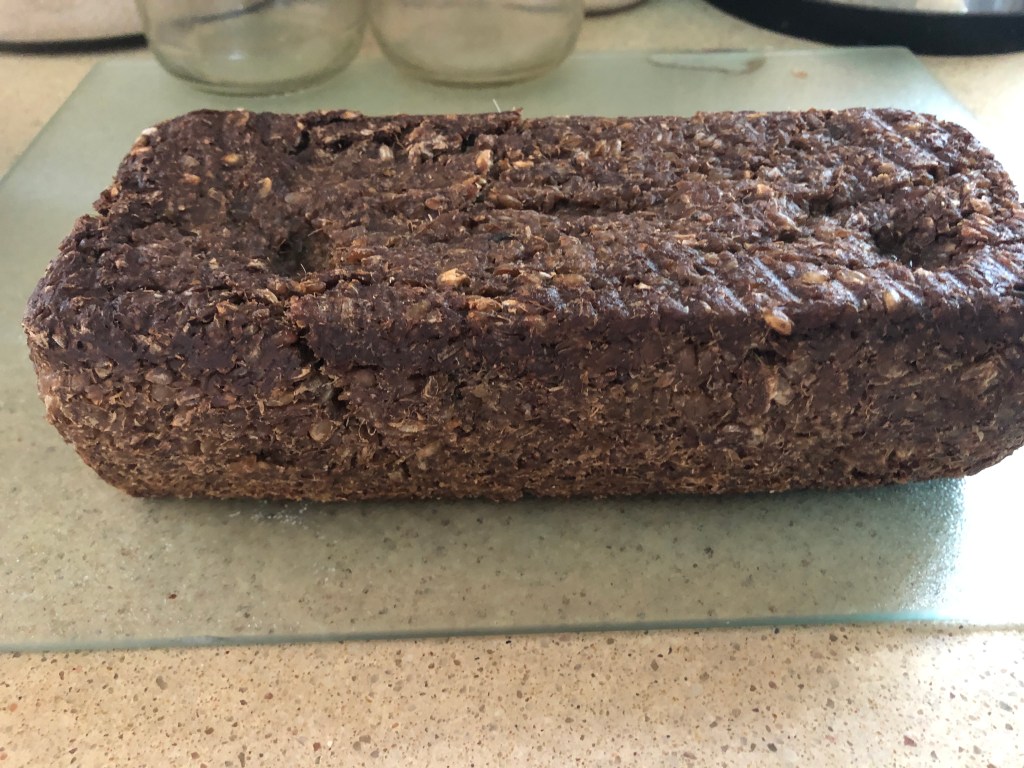
In the process of looking for various ferments, I ran across a recipe in Wild Fermentation for Essene bread. The Essenes were a mystic Jewish sect who flourished from the second century BCE to the first century CE. Essene bread is a sprouted grain bread and I’m not clear on why the Essenes get the credit for it because I’m sure they aren’t the only ones who sprouted their grains before turning them into bread.
Anywho, Essene bread isn’t generally fermented, it’s a flat, or dense, unleavened loaf. But the recipe we followed added in some sourdough starter and fermented for a couple days. Here’s what we did.
We sprouted two cups of rye berries and a cup of wheat berries. This took a 24-hour soak in water and three days of rising twice a day to get all sprouty. Then, James ground it all up in the food processor to make a “dough.” Then added a quarter cup of sourdough starter to the mix. Next, he shaped it into a loaf and put it in a loaf pan, covered with a towel to keep it clean, and set it aside to ferment for two days.
Then, one of two things can happen. It can be dried in the sun for about 8 hours, flipping it over after four hours. Or, it can be baked for several hours at a low oven temperature. We had planned on using the sun oven to bake it this weekend, but with the rain Saturday we went with the oven. James put it in at 200 degrees for a couple hours. When he took it out it was still a little squishy and we weren’t certain if it would “set up” or if it needed more drying time.
This morning it was still squishy so we decided it needed more drying time. It’s pretty sunny today with the occasional cloud, but good enough for a slow dry in the sun oven. James put the bread out for most of the morning, until the loaf turned a nice dark brown. We let it cool a little before slicing into it. Since it is made from sprouted grains and not flour, it still has some squish on the inside and is a little crumbly. How does it taste? It’s delicious!
Because we added sourdough starter and allowed it to ferment for two days, it has a lovely strong sourdough tang to it. We made no other additions; no sweetener, or fruit, seeds or nuts; we wanted to try it plain the first time to see what it would be like. This is not intended to be a sandwich bread. It will make great toast, or a yummy bread to eat with salad or soup. Or even just to have a slice with jam for an afternoon snack. I don’t know about James, but I’m pretty pleased with this one and definitely want to make it again. I think it would be fun to try various grains and grain combinations to see what the taste difference is. Like maybe next time try buckwheat.
The next ferment we are planning on trying is green beans. I am growing purple podded “green” beans in the garden and they turn green when cooked. But if they aren’t cooked and fermented instead, will they stay purple? And if they do, won’t a jar of green and purple beans be pretty? I don’t have enough beans to start a ferment yet since they are just ramping up, but in a few days I think I will. Stay tuned!
Reading
- Book: Her Side of the Story by Alba De Céspedes, translated from the Italian by Jill Foulston. I read this along with my friend Danielle and we had a great email conversation as we read along. The story takes place in Italy just before, during and then after Mussolini and WWII. De Céspedes questions male/female relationships and challenges patriarchal control of women. The first Italian edition of the novel was published in 1949. This is a new translation. If you are a fan of Elena Ferrante, you will very likely enjoy this book, it often has a kind of Ferrante feel to it. Or maybe Ferante has a De Céspedes feel? The story gets a little saggy sometimes, and the main character can be irritating, but the ending was a huge, page turning gasp that had me startle James when I yelled out, “holy shit!.”
- Article: AI supercharges data center energy use—straining the grid and slowing sustainability efforts. The growth of AI and its energy demands is keeping power companies from retiring fossil fuel power plants and even prompting some into considering re-opening closed coal-fired plants in order to meet the growing energy demand.
- Article: Capitalogenic disease: social determinants in focus. The authors propose the term capitalogenic disease as an analytical framework from which to examine global disease and health crises caused by capitalism, “in cases where diseases are perpetuated or exacerbated by specifically capitalist relations of production (profit/growth orientation, restrictive patent regimens, artificial scarcities of essential goods, labour-related abuses and insecurities, hierarchies of exploitation, etc) we must be able to identify and understand these dynamics and respond appropriately.”
Quote
“We didn’t know each other anymore, didn’t remember anything of what we had loved about each other. He knew my romantic nature; how could he have forgotten all that, …? If we had lived during a time of slavery, he would have claimed his rights as a man, he would have fought and killed to prevent one man owning another, because no one is entitled to own the body of another human. You can’t buy the body of a slave, but you can enjoy owning the body of a woman…But if I had decided to leave…, the law would have recognized his right to remain master of my body. He could prevent my making use of it for years, for my entire life, even if he were a bad man, an unfaithful one, or had lived hundreds of kilometers away from me for decades…The only way for me to decide for my own body would be to throw it in the river.”
~Alba De Céspedes, Her Side of the Story
Listening
- Podcast: One Bright Book: In Conversation with David Naimon. One of the hosts, Rebecca, might be known to some of you in the book blogging world as the former Books and Bikes blogger. She and cohost Frances interview David Naimon, the brilliant host of Between the Covers. David actually turns out to be a real human being in addition to literary interview giant. But I had to laugh a few times because he would somehow manage to turn the conversation just enough so that suddenly he was interviewing Rebecca and Frances instead of the other way around.
- Podcast: Planet Critical: The Body Politic: Ranu Mukherjee. The conversation began as one about ruptures and violence and how it lives in our bodies, but ended up as a discussion about time in all of its variety of meanings and perspectives from deep time to plant time and everything in between.
Watching
- Movie: Am I Ok? (2022). This is a delightful best friend movie directed by Tig Notaro who also makes an appearance in it as a goofy New Age guru who runs a hammock retreat (Notaro is such a hoot, I love her. She is on Star Trek Discovery now and then and quite frankly steals the scene whenever she appears.). The movie itself is about two best friends. One gets a work promotion that involves moving to London, the other realizes that she’s gay and is embarrassed that she took so long to figure it out. This is not one of those best friends fall in love with each other movies, so don’t worry. But if you are looking for something funny and sweet with a happy ending, give this one a go.
James’s Kitchen Wizardy
Aside from putting up with all my fermenting project ideas, kitchening has been pretty standard of late, which is nothing to snort at since all the from scratch cooking and baking he does for standard meals is pretty darn amazing.

You are incredible.
LikeLiked by 3 people
Aw Care thanks. But I’m not incredible, just committed 🙂
LikeLiked by 1 person
Good for you! I’m always inspired by your efforts to eliminate plastic and live more sustainably in general.
I was shocked to read the other day that synthetic fabrics release a huge amount of microplastics into water sytems when they’re washed. An article I read said that “One University of California study states that a city the size of Berlin releases the equivalent of 500,000 plastic bags in microfibres during washing every single day.” That sounds way too high, and I couldn’t find the study to back it up, but it’s definitely an issue anyway. So we are going with natural fibres from now on for our clothes and bedding. This stuff is everywhere!
I also second Care’s comment 🙂
LikeLiked by 1 person
Thanks Andrew 🙂
Yes, synthetic clothing releases a huge amount of microplastics. Since we learned that nugget we’ve avoided synthetic fibers as much as possible but it’s impossible to avoid them completely–anything with stretch or elastic uses synthetics. It’s ridiculously impossible to be completely free from plastic but it’s good to try as best we can anyway 🙂
LikeLike
I read about the Essene people in my New Testament class, which is bizarre that I’ve now heard about them twice in the same little bit of time but had never heard of them before.
Is there anything people can do to stop one chicken from injuring another? I don’t want to be delicate about nature or animal instincts, but your durn chicken is being a cluck head!
LikeLiked by 1 person
The Essenes are suddenly everywhere! 😀
Yes Sia is frustratingly a big bully. Aside from separating her or Ethel from the flock of 3 there isn’t really anything we can do. We don’t have the space to keep them separate and even if we did, a solitary chicken is not great because they are flock animals so that would cause a whole other problem. There is no blood being spilled thankfully. So we are hoping Sia will eventually calm down a little after she starts to feel more secure in her head chicken status.
LikeLike
Do they make chicken straightjackets? I KID.
LikeLiked by 1 person
LOL, if only! A little muzzle would work too 😉
LikeLike
Just picture a mashup of Hannibal Lector and a chicken. If I were into AI, I would look into it!
LikeLiked by 1 person
That is rather disturbing 😀
LikeLiked by 1 person
Purple dilly beans do, indeed, stay purple, though not as purple as they come off the plant. And the longer they sit in the brine, the more color they lose. Which always has me asking… where does the purple go? Doesn’t happen so often in my house though because the dilly beans don’t last that long… Seems I can make a batch and within a week they are but a fond memory…
And the Bivo guy is a hoot! One of those people that has me thinking within seconds about “On the Importance of Being Ernest”.
LikeLiked by 1 person
Oh this is great to know about the beans! A great mystery regarding where the purple goes.
Isn’t the Bivo guy a hoot? those Vermont people 😉
LikeLiked by 1 person
I downloaded an episode of One Bright Book. Thanks for the recommendation. I used to read Rebecca’s blog back in the day.
Who wants AI? No one wants it (nobody that’s not a tech bro anyway) and it’s so effing wasteful. ARGHHHH.
LikeLiked by 1 person
Yay! I hope you enjoy the pod Laila! After reading Rebecca for so many years it was strange to hear her voice 🙂
Right? No one asked for AI but they want us to think they have our best interests in mind nonetheless. Grrr.
LikeLiked by 1 person
You already know that our household has been on a steady trend to reduce (imagined: eliminate) plastic. I’m glad to know that there is an option for these portable bottles on bikes (not something I use, my stainless-steel canister rides in my basket, with my book, cuz that’s how lazily I roll when I’m biking, no rattling ensues lol). We’re also trying to steadily reduce what packaging goes into our recycle bin and that’s where we’ve found improvements recently, with a local jam/pickle producer that takes the jars as deposit/refund, for certain kinds of fermented and jammy things that we can’t make ourselves, and to support local growers). We’ve also made changes to our budget so that when shipping is unavoidable for certain products (i.e. when we are not in the city), we can have the maximum quantity shipped (i.e. as rarely as possible) to reduce those shipping resources and emissions. It’s a constant process, and helpful to know that others are working towards these kinds of goals too, because it does take more time and effort, but it’s for good reasons.
I wonder how introducing an/other chicken’s would affect the dynamics. That worked for a friend who was having hierarchy/status problems with their cats. The question is, could it be worse but, maybe, it could be better.
LikeLike
You and your household are doing amazing! Packaging is so hard. We try to limit online purchases and reuse/repurpose as much packaging as possible. That’s really cool about your local pickle/jam producer!
Well, another chicken would change the dynamics, but I would need to add at least two chickens because introducing one to an established flock means everyone picks on the new kid who had no friends. But we have decided we are getting out of chicken keeping because food and bedding has gotten really expensive and since we don’t eat eggs…So no new chickens will be added and these three will have to live out their days together as best they can. Though we have noticed Sia’s calming down and Ethel’s tailfeathers are growing back.
LikeLike
Oh I absolutely love the names for your chickens. I’m still laughing over Sia, though of course not laughing too because that is BAD behaviour (though I suppose chickens will be chickens). I really applaud you going as plastic free as possible. It’s an uphill struggle in the UK because of supermarkets who insist on packaging fruit and veg in plastic. Even the local farm shop, which used to have paper bags, now seems to have resorted to the super thin plastic ones. It’s frustrating.
Oh gosh, that was one massive rain storm! We could do with rain – in a heatwave here and sweltering, and what’s the betting we’ll have a deluge rather than the steady rain the land needs? I hear you about learning all kinds of climate terms that it would be so much better not to need.
And I must listen to the podcast with Rebecca in!! How lovely that she’s still doing bookish things.
LikeLike
Thanks! Sia was the prefect name for a black chicken with a white bouffant 🙂 Since her elevation to Head Hen, all the power has gone to her head.
Going plastic free is a struggle everywhere. The economy does not support it, sadly, and then individuals get blamed for not recycling when most of the plastic that goes to be recycled is not recycled. It’s very frustrating!
I hope your heatwave broke and you got some gentle rain!
LikeLike