
Last July I mentioned how I tried to zero out my Goodreads Challenge number in an attempt to move my reading away from a consumer capitalist, must read as many books as I can, must be productive mindset. I struggled to lower the number, because, what would people think? I’m a reader, dammit, I read a lot of books! When I did try to change the number to zero, Goodreads wouldn’t let me. Trapped in the Amazon net, did I simply change the number to “1”? Nope. I was mentally unable to do it. I lowered it to 30 books. And when my book count was 31, I was ridiculously thrilled and appalled at being so thrilled.
This year, in spite of Goodreads emailing me several times to remind me to set a goal, and despite the Reading Challenge widget telling me to “Challenge yourself to read more this year!” every time I login, I have not set a goal. In fact, I am weaning myself away from Goodreads entirely because I don’t need Amazon keeping an eye on me, nor do I need to be encouraged to read more. Instead, I am working out a way to use LibraryThing to keep track of what I have read, not so I can have a number at the end of the year, but only as a means to help me remember a few years from now whether or not I’ve read that book that seems so familiar.
I am not the only one these days thinking about capitalism and reading. Molly Templeton has a fantastic essay at Reactor (previously Tor), asking Why Are We Talking About Books Like This? Her “feelings” about how we talk about books started awhile ago, but boiled over with a Washington Post poll about reading that horrified her when it framed “big readers”—those who read more than 50 books in a year—as being the “true one-percenters: people who read more books than 99 percent of their fellow Americans.”
Templeton rightly points out, “You know what this framing does? This presents reading as an elitist activity. Again.” And she goes on to say, “We don’t need to be set apart by the language of capitalism, described using the language of the ultra-wealthy, as if books make you a billionaire.”
Why do we keep talking about books and reading like this, she wonders. Who does it benefit? Of course it benefits Amazon, Jeff Bezos owns the Post after all. And it benefits private equity firms and corporate publishing. But does it benefit us as readers?
Shannon Reed doesn’t think so. She recalls plowing throw books when she was a kid to earn free pizza from Pizza Hut. She was already a reader, but reading for prizes taught her how to skim. “I’m sure you’re familiar,” she writes,
You have to read a book for some reason, and you’re not that excited about it …, but you’re a good person, you’re not going to say you read a book if you didn’t. So you run your eyes over every single line. And yet, when you get to the end, much more quickly than you should’ve, you’d be hard-pressed to explain even the basics of the book.
Even after she no longer read to earn pizzas, she found herself reading like that; she got praise, she passed her English class tests, and she “still somehow believed that adding to my growing stack of books marked read mattered more than what I got from the experience of reading them.”
Not until she got to graduate school did she begin to have problems, “I realized that I had to slow down, to read less in order to understand more. It wasn’t easy to learn to do this.”

Reading is not a race, she says, but a lifelong companion. Oh sure, you might argue, it is a race, a race against mortality. I have a lot of books to read before I die. But there will always be more books. We will never read them all, so what does racing gain us, especially if in a week or two we have no recollection of what we have read? If we have no understanding?
This is not to say that books and reading can’t be escapist and fun, a little brain candy. They absolutely can be. However, there is way too much about reading as medicine, reading as being good for you, reading as broccoli (I love broccoli, but you know what I mean, eat your vegetables!). Such thinking tips over into making us feel guilty for not reading “important” books. It also edges into demanding that books “do something.”
Like the idea that is big in climate activist circles insisting we need to tell better stories about climate change so people will stop being apathetic and actually DO something. As Emma Pattee writes in her essay, “On the False Promise of Climate Fiction”:
I frequently find myself in conversation with people who want to wax poetic about Kim Stanley Robinson’s visionary climate novel, Ministry for the Future, but shy away when I talk about the painful grappling my family is doing around the idea of giving up air travel. Buying books will always be easier than questioning one’s own consumption. Besides, people are busy. As Schneider-Mayerson explained, ‘There are so many economic, social, and cultural pressures, incentives, and norms that encourage us to go back to sleep—to focus on other things.’
Schneider-Mayerson, quoted above, is Associate Professor of English at Colby College, who, in collaboration with the Yale Program on Climate Change Communication, performed a little experiment. They used two short stories about climate change to test the impact on readers. They found that immediately after reading the stories, readers showed a small increase in concern. However, this concern faded after only one month. No one was prompted to act or make any life changes.
In fact, Karen Russell relates that after her story “The Ghost Birds” appeared in The New Yorker, one commenter said that it didn’t want to make him save the planet, but instead made him want to save as much money as he possibly could to leave to his children so they could buy water and air.
In The Great Derangement Amitav Ghosh takes writers to task for not writing stories that include climate change, which is fair. However, now that more and more novels do include climate change, it seems to be mostly background (realism!) in many cases. Not that every book needs to stare head-on into the abyss, but telling better stories doesn’t appear to be making much of a difference.
Etaf Rum has also discovered that stories don’t always prompt people to be their best selves. In spite of studies showing how reading makes us more empathetic, and by extension, better people, Rum has found that is not necessarily so. Rum is Palestinian-American and has written books and stories about Palestinians based on her family experiences. She has received much praise for her books and comments from many readers expressing empathy for Palestinians.
Until October 7th.
Recently she has been “bombarded” with messages from readers who are angry with her unwavering support for Palestinians. She was surprised and hurt, and concludes,
The genuine astonishment many readers experienced when learning about my support for Palestine exposes a troubling reality—the prevalence of performative empathy within the reading community. There is a clear disparity between the empathy they felt for my fictional characters and their ability to apply it to the real-life humans suffering in Palestine.
Yet, with all the book-banning efforts in the United States, books clearly have power. Rebecca Gordon writes for Tom Dispatch:
Contemporary book-banning efforts extend beyond school libraries, where reasonable people might differ (a little!) about what books should be available to children, to public libraries, where book banners seek to keep even adults from reading whatever we choose. EveryLibrary, an anti-censorship organization, keeps a running total of active “legislation of concern” in state legislatures that relates to controlling libraries and librarians. They maintain a continually updated list of such bills (the number of active ones changed just as I was exploring their online list). As of today [February 11], they highlight 93 pieces of legislation moving through legislatures in 24 states as varied as Idaho and Rhode Island.
Books and reading matter a great deal. Books have, and do, change lives everyday. As William Carlos Williams wrote:
It is difficult
“Asphodel, That Greeny Flower“
to get the news from poems
yet men die miserably every day
for lack
of what is found there.
I think, as readers, we get a little too full of ourselves sometimes and forget. We forget what reading is all about. It’s not how many books we read in a year. It’s not whether we have read Anna Karenina or Don Quixote or some other weighty classic we somehow feel obliged to check off our list. It’s not whether we have read all the prize-winning “important” books at all. It’s about whether we have read, actually read, paid attention to, thought about, allowed the story to enter into us, to change us, that’s what matters. And it doesn’t require capital “L” Literature at all. It doesn’t matter what we read, but how.
So I’ve been practicing presence when I read, being there in the story, paying attention and not thinking I need to hurry up and finish this book because my TBR pile is about to tip over. I keep reminding myself that it’s not the person who has read the most books when they die who “wins.” What does that even mean? I’m trying to read like I did when I was a kid, when all that mattered was being in the story and loving the entire experience, getting lost, being found, and coming up for air to see the world in a different light. It’s hard. Currently it’s work. But every now and then I manage to slip into the story river and eventually wash up on the shore, breathless and dazzled.
Reading
- Article: Leaked Emails Reveal Hugo Awards Ineligibility Details. Speaking of reading, I’ve been kind of following the Hugo Award fiasco in which some works and authors were quietly banned from being on the ballot even though they qualified because the award organizers were concerned about offending the Chinese. The 2023 award ceremony was held in Chengdu, China last October.
- Article: Rubble from Bone: Tom Stevenson Writes About Operation Iron Swords. This is a most excellent article at the Times Literary Supplement about Palestine and Gaza and Israel and what has happened in the lead up to the genocide that is presently occurring there.
Listening
- Podcast: For the Wild: Merlin Sheldrake on Embodied Entanglements. Sheldrake is the author of the bestselling book about fungi, Entangled Life: how fungi make our worlds, change our minds & shape our future, a book that’s on my TBR. I have seen the completely unrelated movie Fantastic Fungi though. Fungi are amazing beings, and if you want to get jazzed up about them, listening to Sheldrake is a good place to start.
- Podcast: This Machine Kills: Kill the Ecomodernist in Your Head. This is a new to me podcast and I picked an episode near the end of last season and felt like I was dumped into the middle of a conversation. It took me a bit to orient, but once I did, I really liked the episode and will be listening to others for sure. They hosts are anti-capitalists and talk a lot about Marxism, but aren’t full-on Marxists. This particular episode goes all over the place talking about degrowth and capitalism and finally lands on an extended conversation about how socialist capitalism, a kinder, gentler capitalism, is completely bogus.
Watching
- Movie: Anyone But You (2023) James wanted to watch a romcom and came up with this one. It’s very Millennial and predictable, but has some good, funny moments. Many of the best laughs were because of a minor character who is an energetic Australian surfer dude.
Quote
What do you value? What do you want to raise up in this world, this big world in which we live brief lives? How do you want to shape things with language, within a life, with the way we interact with the world? What role does art play in your life? What role beauty? What do you want to set free rather than consume?
Molly Templeton, A Reader is Not a Consumer of Books
James’s Kitchen Wizardry
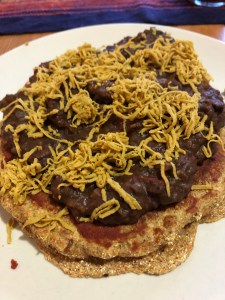
Tuesday was National Pancake Day and the chili from the other week didn’t stay in the freezer for long. Instead of turning into chili cheese fries, James made two big cornbread pancakes and the rest of the chili went on top. So good! And a great way to celebrate the versatility of pancakes!
James likes to make treats on the weekend, and yesterday he made chocolate coconut mocha muffins. When I asked where he had found the recipe he replied, I pulled it out of my ass. James frequently pulls recipes out of his ass. His ass is very productive that way. I will only suggest he see a doctor about it if the recipes begin to go bad.


LOL about the recipe pulling! I envy people who can do that – cook without a recipe. That’s not me.
What an an interesting article about reading and consuming. I really hate the word “content” applied to everything. I have been trying to push back against the internal and external pressure to read fast or a certain number of books. I made my “goal” 1 book this year just to have the graphics to help me at the end of the year when I look back at what I read. But I do still have the feeling of “I want to read ALL the books before I die!” Which I know is not logical or possible. But then I think, as long as I’m enjoying what I read or learn something, it’s all fine.
Re climate change and books: I honestly tend to avoid fiction where climate change is featuring heavily. I just can’t bear it. It’s too sad. News articles are bad enough. So I keep my fiction more for escape from reality. It’s not because I don’t care, it’s because I care a lot and can’t handle it.
LikeLike
I used to not be bothered by calling everything online “content,” but seeing how it has evolved, how it hides and mislabels, I no longer can go along with its use. All the internal and external pressure when it comes to reading is so fascinating. I never used to think about it until the last couple of years, but I think it’s something readers need to consider and not simply go along with.
Curious Laila, is there any sort of fiction that includes climate change that you would consider reading?
LikeLiked by 1 person
Well, if Ann Patchett or Kate Atkinson or one of my favorite writers wrote something including that, I would read it. Actually Barbara Kingsolver did write a couple of books that have included those themes and I read those. So it has to be something like that. I eschew dystopian fiction in general as well. Not that I don’t read sad things but they’re more interpersonal sad things, I guess.
LikeLiked by 1 person
Ah, so it’s the dystopian climate change novels you won’t read, but if it’s included as part of a story but not specifically the story, you will read it. Makes complete sense! I’m tired of the dystopian novels too. It’s much to easy to imagine the end of the world and everything going to poo than it is to imagine how we might survive and adapt and create something new instead.
LikeLiked by 1 person
I would be interested in that!
LikeLiked by 1 person
Thank you Laila for answering my curiosity!
LikeLiked by 1 person
You can import to LT from GR but the shelves don’t transfer tidily. Still, LT does have some really great features and they’re seemingly quite committed to maintaining their independence from the behemoth!
When do you do all your podcast listening? Are there some that you listen to loyally or are you more of a browse-listener? That movie looks cute. We watched Three Thousand Years of Longing.
LikeLike
I exported and printed my GR list. Trying to transfer to LT and then having to clean it all up is more hassle than I’m willing to cope with 🙂
I do my podcast listening on Sundays while I am doing household chores. Loyal listener of Crazy Town and Scene on Radio. Everything else I selectively listen to based on what the episode is about.
Three Thousand Years of Longing is a good one! I love Tilda Swinton and she and Elba were so good together.
LikeLike
I kind of went the opposite way… I increased my goal last year, and I ended up reading a LOT more than usual (79 books! Pretty good for me and my crazy busy life). I did have some mixed feelings about it, but in the end it made me personally very happy to have read all those books and having the arbitrary goal helped keep me motivated to read. I did skim some though, but I do that anyway with books that I want to know what happens, but I don’t care enough to deeply read. Anyway, definitely arguments for both ways. I took a few years where I just read at “my own pace” and it was way more relaxed. But, then I felt sad that I hadn’t read more books. So… you know. So it goes. However, I steadfastly hold to my dedication to reading on a whim — I never ever stick to a reading plan, barely can manage to read what my bookclub is reading, and only read what I want, which can be anything. I read a lot of fluff last fall and winter and it was exactly what I needed. This year I’m trying to read more “good stuff” but it doesn’t matter. I don’t judge what I read — that’s my one rule!
LikeLike
Oh so much here to digest and comment on Stefanie. I’ll start though by saying that I have not found it hard to resist GR’s exhortation to me to set a reading goal. I never have there and never will. I’d like to think I was completely above the “competitive” aspect of being a reader. I mostly am, until it comes to end of year lists and the number of books some of you read is astronomical. I don’t share the number I read. I almost always talk in terms of percentages, because that in a way is better at conveying the quality of my reading. To say I read X number of First Nations books means not very much, to me, but saying 25% of my reading was by First Nations authors gives a good sense of what I am achieving in terms of diversifying my reading.
I also stopped being a page-turning reader a long time ago. It’s one of the reasons my actual numbers read each year are low. The other reason is that life seems busy and I really only manage to read for a very small amount of time each day – an hour often is all I get. (Of course, if I were not reading blog posts and writing long responses I’d get more reading done.) My current book is not very long, just 277pp., but I will struggle to finish it for reading group in 5 days time because every page – every page – has an idea I need to stop and think about. It’s almost unbearable to read in fact because how can I absorb such intensity.
I’m interested in your comments about LT and GR. I started with LT, but then moved to GR because that’s where the people were, but recently I’ve been thinking of returning to LT. I really need to think though what I want from them. Do I need them at all?
Love the cornbread pancakes and chilli. My mouth is watering. Good on James and his ass. I am not really a muffin fan, but I am a fan of creative wizardry in the kitchen.
LikeLike
Oh WG, thank you for such a thoughtful comment! I am glad you have not found it hard to resist GR’s goal setting. I love the reasoning behind how you do your end of year recaps! You know, I have never noticed that you don’t say how many books you have read! That’s probably because all the things you do talk about are so much more interesting.
That sounds like a really intense book you are reading! I also admire that you are taking to time to read it and not rushing to finish it before your book group meets. What a shame it would be to rush such an experience.
I’ve worked out how to use tags on LT for “currently reading” and “read 2024” to help me find and sort books. I also have a “wishlist” collection and a “Read but not owned” collection for books I read from the library or lent by friends. The book record also allows you to write a review, rate the book, keep track of start and end dates, and also make additional notes. It does have a social aspect too, not quite like GR, but you can follow people and send messages, etc. It is feeling quieter and calmer for me and I like that.
I am a fan of kitchen wizardry too, especially when I’m not the one who has to do it 😀
LikeLiked by 1 person
Thanks Stefanie… I will get back to thinking more about LT soon.
LikeLiked by 1 person
If you go the LT direction let me know so I can follow you 🙂
LikeLike
I’m already there Stefanie … joined around 2007 or so, before my blog. I’m minerva2607. I just don’t use it much. I even bought a cue cat barcode reader back then to enter my books! Way before we had devices with barcode reading cameras 😊
LikeLike
Why didn’t I know this? I have added you to my friend list in case you are wondering who wellred2 is 🙂
LikeLike
I think we did know this way back when but have forgotten because life just kept moving on?
LikeLiked by 1 person
I suspect you are right about that! 🙂
LikeLiked by 1 person
It’s amazing how the years have flown since, for example, you were doing your library studies!
LikeLiked by 1 person
I know! In some ways it seems like just yesterday and in others it feels a very long time ago 🙂
LikeLike
You hit it in one!
LikeLiked by 1 person
Today was a tough day, and the comment about James’s ass was my favorite part of it. Thank you for that. I do love this post. I stopped using Goodreads because I didn’t like that people wouldn’t comment on my reviews or reply to me, and then I wondered why I was looking for external validation. I left and got The Storygraph, where I interact with on one. I find it’s a great tool to keep track of books I want to read or did read so I don’t have to create a list on an Excel spreadsheet. I definitely do not have a goal of reading X number of books per year. In fact, I believe I stopped counting even in my end-of-the-year stats. I have also found that by “shopping” at the library, I’m happy to get a lot of items and then send them back, even if I did not read them, and I feel guilty for neither activity. My big concern is that I get distracted while reading one book because the information in another sounds so neat. Like this new book about taking care of yourself by analyzing plants. Or the one about earthquakes in history. Or the one about Salman Rushdie surviving an attempted assassination. Etc. I do find myself turning away from bloggers who use Literary as a smug term too often. Literary once in a while, okay, but not “this book is not Literary” bloggers. I just can’t. I find myself turning more to horror fiction, which I love, and ignoring the bloggers who are happy to read “Literary horror” and want to connect with me.
LikeLiked by 1 person
Heh, glad James’s ass provided some amusement especially on a tough day!
I’m glad you have found Storygraph to be so useful. I tried it out early on and then tried it again recently and just didn’t get on with it. I’m finding I like LibraryThing pretty well. I get distracted by other books and articles mentioned in the book I am reading too! I generally end up with lists of books and downloaded articles the author mentions and cites to and of course I don’t get to most of them and then I find the lists and article folders months later and wonder why I was so very interested in them. :D
LikeLike
Oof, I feel you.
LikeLike